On this page
Bengaluru has become one of India’s most active cities for direct-to-consumer and sustainable fashion. Labels selling organic cotton shirts, handloom co-ords, linen dresses and slow-fashion basics are launched here every month, often by founders who care deeply about materials. Yet many of these garments still close with polyester buttons. For a brand that talks about natural fibres, that is a small contradiction customers increasingly notice. This guide explains how Bengaluru brands can replace plastic with natural shell buttons, and how to talk about the change honestly.
Why buttons matter for a sustainable brand
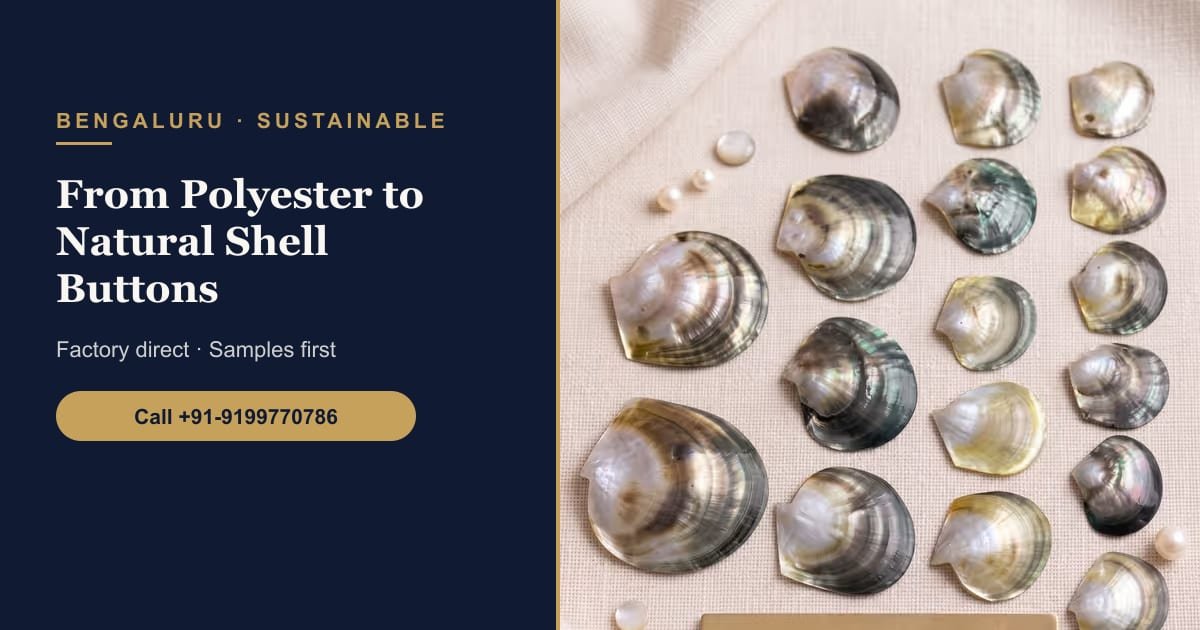
Most standard buttons are made from polyester resin, a petroleum-based plastic. They are cheap and consistent, but they never biodegrade and they look and feel synthetic. Natural shell buttons are cut from the hard inner layer of shells — the same material as mother of pearl — and are a natural, biodegradable material. On a garment made from cotton, linen or handloom fabric, a shell button keeps the whole product natural, from fibre to fastening.
There is also a quality argument. Shell buttons feel cool and solid, show natural lustre and variation, and handle ironing without softening. Customers who handle the garment notice the difference even if they cannot name it.
What to claim, and what not to
Sustainability messaging must be accurate. It is fair to say your buttons are natural shell, plastic-free and made from a biodegradable natural material. Avoid vague or unverifiable claims such as “zero impact”. If you make specific claims about sourcing or certification, make sure you can document them, and ask your supplier for whatever information you need for your own records. Honest, specific statements build more trust than big promises.
Choosing the right shell buttons for slow fashion
- Natural cream shell suits undyed, ecru and earthy fabrics and has a warm, handmade look.
- White mother of pearl works on white shirts and pastel dyes.
- Mixed natural grades embrace variation — perfect for brands that celebrate imperfection.
- 2-hole designs look minimal and modern; 4-hole feels classic.
- Sizes from 14L to 20L cover most shirts and dresses; 24L+ for jackets and statement pieces.
Small batches and D2C realities
D2C brands rarely produce tens of thousands of a single style. You may launch a capsule of five styles in a few hundred units each. For that scale, it is sensible to standardise on two or three button styles across your whole range, so that you can order economical quantities per size and reorder easily. For very small requirements, retail packs from our online shop are available; for production runs, wholesale pricing applies.
Natural dyes and care
Many sustainable brands use natural or low-impact dyes and gentle garment washes. Shell buttons are usually attached after dyeing; if buttons must go through a dye or wash process, test samples first, since strong chemicals can affect the surface. On your care label, “natural shell buttons — avoid bleach” is a helpful line that also reinforces the material story.
Telling the story
Customers buying from conscious brands enjoy knowing how a product is made. You might include a line on your product page — “finished with natural shell buttons, cut and polished in India” — a macro photo of the button, and a short note in your packaging. Keep it factual and specific, and let the button speak for itself.
Practical checklist for switching
- List every style and the buttons it uses today.
- Consolidate to as few sizes and shades as possible.
- Order samples and try them on each fabric.
- Update tech packs and care labels.
- Place a bulk order sized for a season, with reorder points.
- Update product pages and photography.
Packaging and the unboxing moment
For D2C brands, the moment a customer opens the parcel is part of the product. A small card explaining that the buttons are natural shell, perhaps with a spare button tucked into a paper sleeve, turns a hidden detail into a visible one. Customers who notice it often mention it in reviews and social posts, which is exactly the kind of organic word of mouth Bengaluru brands rely on.
Working with your production partner
Many Bengaluru D2C labels produce through contract manufacturers rather than their own factories. If that is your model, buy the buttons yourself and send them to the factory with a written spec, rather than letting the factory substitute locally. It keeps your sustainability promise intact and ensures every batch looks the same.
FAQs
Are shell buttons vegan?
Shell is an animal-derived material, so shell buttons are not considered vegan. Brands with a vegan positioning may prefer other natural materials such as wood or corozo; brands focused on avoiding plastic usually choose shell.
Will natural variation look inconsistent?
We sort by shade within each grade. For a uniform look choose a tight grade; to celebrate natural variation choose a mixed grade.
Ready to go plastic-free on your buttons? Call +91-9199770786.
Order from the manufacturer
Need shell buttons for Bangalore?
MyPearlCraft has made natural shell and mother-of-pearl buttons for 50+ years in its own unit. Send size, hole type, shade and quantity — or a photo of your sample button.
- 01
Send your spec - 02
Get a quote - 03
Approve samples - 04
We make & ship
Stock sizes usually start at 500–1,000 pieces per size for wholesale pricing (confirmed in your quote). Samples first. GST invoice on every order.
Topics