On this page
Every shirt programme that leaves a Bengaluru factory carries a trim sheet, and the button line on that sheet decides how the finished garment looks and feels. Merchandisers in Peenya, Bommanahalli and along Mysore Road regularly receive specifications such as “MOP 18L 4H 1.8 mm, polished, white”. This guide explains what each part of that line means, how to choose sizes and thickness for different shirt styles, and how to write a specification that a mother-of-pearl button manufacturer can follow exactly.
Ligne: the button industry’s unit of size
Buttons are measured in ligne (written L). One ligne equals 0.635 mm, so a button’s diameter in millimetres is its ligne number multiplied by 0.635. The sizes you will meet most often on shirts are:
- 14L ≈ 8.9 mm — collar points, button-down collars, cuffs on lighter shirts, kidswear.
- 16L ≈ 10.2 mm — cuffs, sleeve plackets and fronts on fine shirts and blouses.
- 18L ≈ 11.4 mm — the standard front-placket size for men’s shirts.
- 20L ≈ 12.7 mm — heavier shirts, kurtas and casual overshirts.
- 24L ≈ 15.2 mm — overshirts, shirt-jackets and dresses.
- 28L–36L ≈ 17.8–22.9 mm — jackets, coats and statement designs.
When a buyer gives only a millimetre value, convert it to the nearest ligne, but always share the original number with your supplier as well. A difference of half a millimetre can change how a button passes through a buttonhole made on an automatic machine.
Thickness: the detail most specs forget
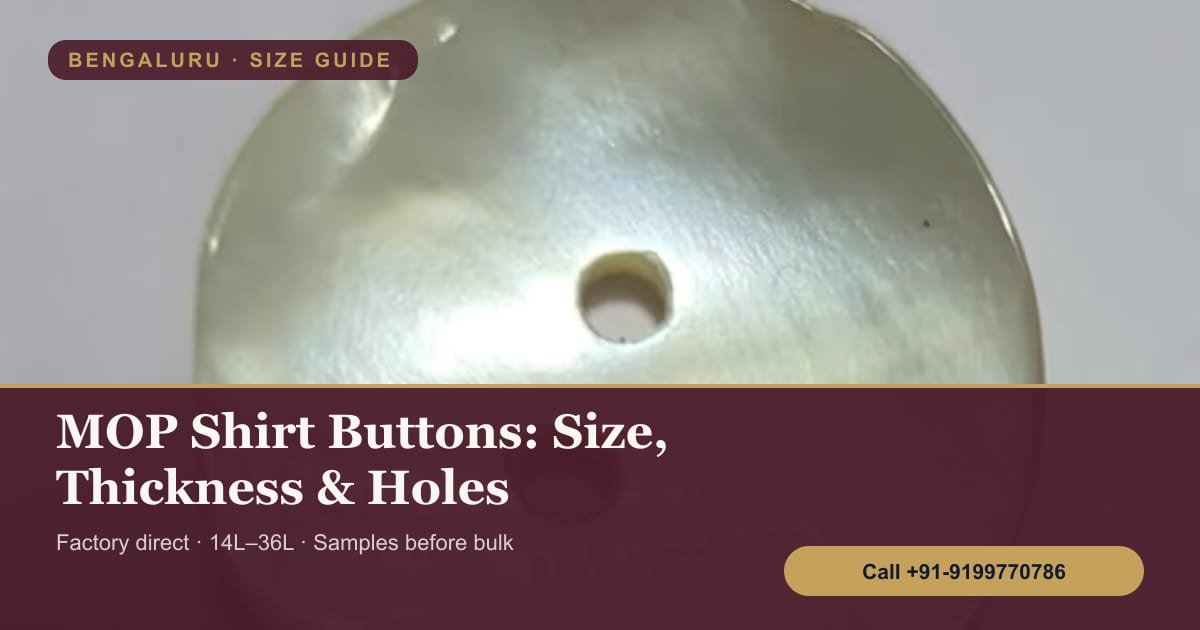
Two buttons of the same diameter can feel completely different if one is 1.6 mm thick and the other 2.4 mm. Thicker mother of pearl feels more luxurious and is common on premium formal shirts, while thinner buttons sit flatter under a tie and suit lightweight fabrics. As a rough guide, shirt fronts in 18L commonly fall somewhere between about 1.8 mm and 2.5 mm, but the right value depends on your buyer’s standard. If the trim sheet does not mention thickness, ask the buyer or send them two sample thicknesses to choose from — it prevents arguments at final inspection.
Thickness also matters for production. Automatic button-sewing machines are set up for a thickness range, and buttons that vary too much will cause skipped stitches and needle breaks. That is why a good manufacturer sorts every lot for thickness as well as shade.
2-hole or 4-hole?
- 4-hole is the classic for formal and business shirts. It sits securely and can be sewn with a parallel or cross stitch, which some brands use as a signature detail.
- 2-hole looks cleaner and more modern, and is common on casual, linen and fashion shirts, and on womenswear.
Hole size and spacing should suit your machine needles and thread. If your factory uses a particular hole pitch, put it in the spec; on bulk orders we can drill to match.
Rims, faces and finishes
A shirt button may have a flat face, a gently convex face, or a raised rim around a dished centre that protects the thread. Each gives a slightly different look. Finish ranges from high polish, which shows the full iridescence of mother of pearl, to a softer natural or satin finish that suits casual and linen shirts. White MOP is the reference for formal shirts; natural cream shell suits ecru, khaki, chambray and earthy colourways.
Shade and grading
Because mother of pearl is natural, no two buttons are identical. Manufacturers grade buttons by shade and clarity. For a premium white shirt, you want a tight, bright grade; for a casual linen programme, a wider, natural range can actually look better. Agree the grade with your buyer using physical samples, then keep one sealed reference card in your trims store and one with your supplier so that every reorder is checked against the same standard.
Writing a specification the factory can follow
A complete button spec for a shirt programme usually covers:
- Material — mother of pearl, natural shell, or a named shell type.
- Size — ligne and millimetres.
- Thickness — with an acceptable tolerance.
- Holes — 2 or 4, plus pitch if critical.
- Face and rim — flat, convex or rimmed.
- Finish — high polish or natural.
- Shade grade — referenced to an approved sample.
- Quantity per size, including spares and wastage.
Send this list, or simply a photo of the buyer’s trim card, and we will quote and prepare samples to match.
Planning quantities
A typical men’s shirt uses seven or eight front buttons, two or three on the collar, two on the cuffs, two on the sleeve plackets and one or two spares — often 14 to 16 buttons per shirt across two sizes. Add an allowance for machine wastage and rejections when you place the order, and confirm whether the buyer wants spares attached to the care label.
FAQs
Can you match a button from a previous buyer programme?
Yes. Send the button or a clear photo with measurements, and we will match size, thickness, holes and finish as closely as natural material allows, with samples for approval.
Can you supply two sizes for the same shirt from one shade lot?
Yes. Tell us both sizes in one order and we will sort them together so the collar and front buttons match.
Questions about a spec? Call +91-9199770786 and speak to the manufacturer directly.
Order from the manufacturer
Need shell buttons for Bangalore?
MyPearlCraft has made natural shell and mother-of-pearl buttons for 50+ years in its own unit. Send size, hole type, shade and quantity — or a photo of your sample button.
- 01
Send your spec - 02
Get a quote - 03
Approve samples - 04
We make & ship
Stock sizes usually start at 500–1,000 pieces per size for wholesale pricing (confirmed in your quote). Samples first. GST invoice on every order.
Topics