On this page
- Why natural fabrics deserve natural buttons
- Choosing the shade
- Size and thickness for light fabrics
- Two holes or four
- Attaching on light fabric
- Washing and ironing
- Buttons as part of the brand story
- Buying for a small label or tailor
- A simple selection guide
- Matching buttons to fabric weight
- Selling the difference to customers
- Handling returns and care questions
- Planning reorders for a growing label
In a climate like Chennai’s, linen and cotton are not a fashion statement; they are what people actually wear. That makes the shirt a competitive product, and in a crowded market, the small details are what separate a premium shirt from an ordinary one. The button is the first of those details: customers touch it every morning. This guide helps shirt makers, tailors and boutique labels choose natural shell buttons that suit light natural fabrics and survive hot-weather laundering.
Why natural fabrics deserve natural buttons
A linen shirt is sold on texture and honesty of material. A glossy plastic button with a mould line sits at odds with that story, while a natural shell button has the soft lustre and slight variation that match it. Customers who pay more for linen tend to notice and appreciate the difference, and it gives you a simple line for your label: natural fabric, natural button.
Choosing the shade
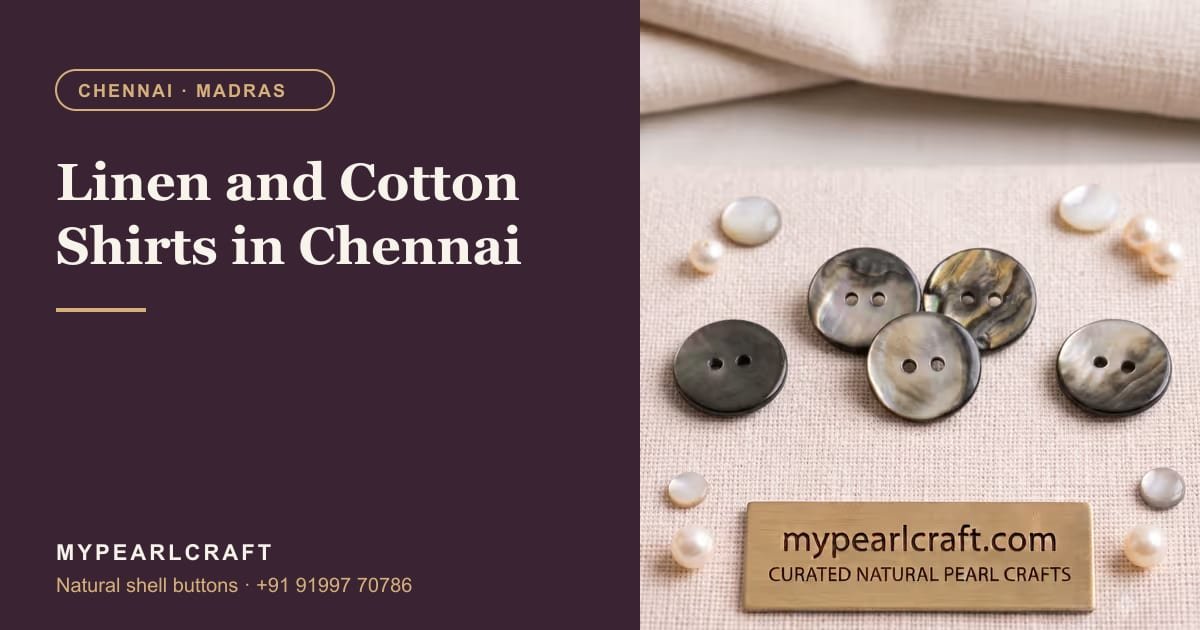
On white and pastel linen, natural cream shell looks warm and relaxed, while bright white MOP can look stark. On deeper colours — navy, olive, terracotta — white pearl gives a crisp contrast, and cream gives a softer, vintage tone. If you work in earthy dyed linens, cream usually blends; if you want the buttons to stand out, go white. Always view the sample against your actual fabric in daylight.
Size and thickness for light fabrics
Linen is light and often loosely woven, so a heavy button can pull the placket and create ripples. For everyday shirts, 16L–18L in a moderate thickness is a safe choice; for a casual overshirt or kurta-style linen shirt, 20L–24L gives a more prominent look. Test one or two buttons on a finished placket and check that the garment still hangs well when buttoned.
Two holes or four
For a relaxed linen shirt, 2-hole buttons look quiet and modern. Four-hole buttons give a classic tailored look that suits cotton formal shirts. Many Chennai makers use two-hole on casual resort shirts and four-hole on office shirts, keeping the shell material the same across the line.
Attaching on light fabric
Light fabric can fray around the button, so reinforce the placket with interlining or a small backing patch. Use thread suited to the cloth — cotton or cotton-poly — and keep tension even. If you use automatic attach machines, run a short test to make sure the holes and thickness suit the setting, and consider a shank or a little thread length so the button sits comfortably.
Washing and ironing
Shell buttons are durable, but they respond badly to harsh treatment. Advise customers to wash normally with mild detergent, avoid bleach that touches the buttons directly, and iron around them rather than over them. If your garments go through an industrial wash, attach buttons after washing where you can. Where not, test a few samples through the full recipe first; heat and strong chemicals can dull the polish.
Buttons as part of the brand story
Because every shell button is cut from real shell, each one is a little different, and that is a selling point rather than a flaw. Mention "natural shell buttons" on your hang-tag or website, and include a line in care instructions. Small touches like this help a local label justify a higher price against mass-produced shirts.
Buying for a small label or tailor
Not every maker needs thousands. Tailors and boutique labels can start with small packs in a few sizes and shades, learn what works, and move to wholesale when demand is steady. Keep a note of which size and shade went on which style, so repeat orders are accurate and quick.
A simple selection guide
- Everyday cotton shirt: 18L, 4-hole, white MOP.
- Relaxed linen shirt: 16L–18L, 2-hole, natural cream.
- Overshirt or kurta-style: 20L–24L, natural shell, mixed shades.
- Ladies’ blouse: 14L–16L, 2-hole, smooth edge.
Matching buttons to fabric weight
Fabric weight changes everything about button choice. A fine cotton voile needs a small, thin button that will not drag; a heavy linen canvas can carry a larger, thicker one. Hold the button against the cloth and fold the fabric over it: if the fabric creases around the button, it is too heavy for the cloth. Testing takes a minute and prevents rippling plackets in the finished shirt.
Selling the difference to customers
Customers rarely know what shell buttons are until you tell them. Put a short line on the hang-tag, such as "natural shell buttons", and mention it in product descriptions online. A label that explains its materials clearly can justify a modest premium, and shoppers who read the tag are more likely to remember the shirt next time.
Handling returns and care questions
Most complaints about shell buttons come from care, not quality: bleach, hot irons or rough machine washing. A simple care card with the shirt reduces these, and checking the first customer feedback after launch tells you whether any detail needs changing. Small makers who respond quickly build the reputation that keeps customers coming back.
Planning reorders for a growing label
When a style sells well, the reorder should arrive before the shelf is empty. Keep a simple record of the button size, shade and holes used on each style, and the quantity bought last time. When stock of the shirt falls to a set level, place the trim reorder at the same time as the fabric order. That way, buttons and cloth arrive together and the next batch looks exactly like the first.
We manufacture natural shell and mother-of-pearl buttons and ship to Chennai by courier or transport. Tell us your garment, size and quantity, and we will send a quote and samples to try on your own fabric.
Order from the manufacturer
Need shell buttons for Chennai?
MyPearlCraft has made natural shell and mother-of-pearl buttons for 50+ years in its own unit. Send size, hole type, shade and quantity — or a photo of your sample button.
- 01
Send your spec - 02
Get a quote - 03
Approve samples - 04
We make & ship
Stock sizes usually start at 500–1,000 pieces per size for wholesale pricing (confirmed in your quote). Samples first. GST invoice on every order.
Topics