On this page
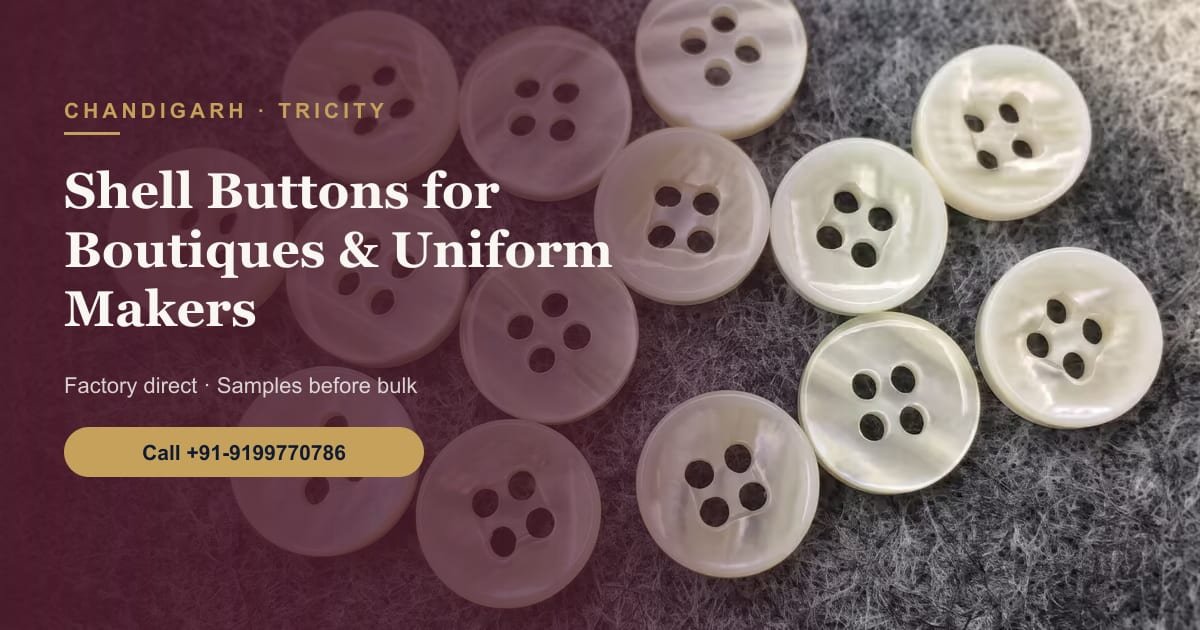
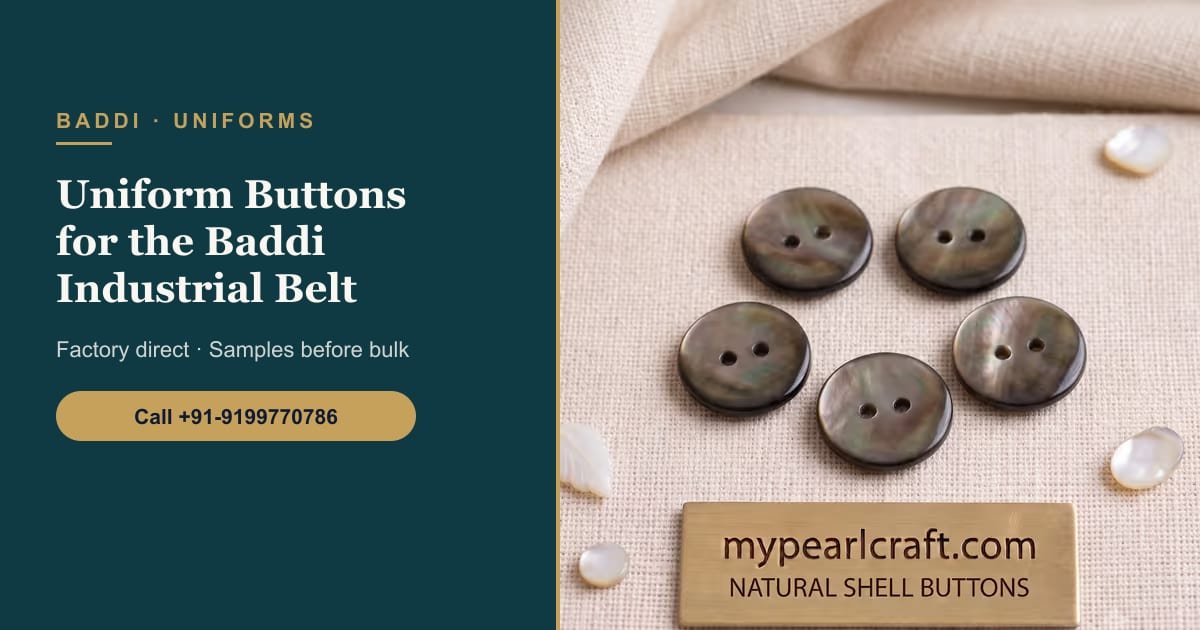
The Baddi–Barotiwala–Nalagarh industrial belt on the Himachal–Punjab border is one of North India’s busiest manufacturing regions, best known for pharmaceuticals, FMCG and packaging plants. Every one of those companies puts its people in uniforms: shop-floor shirts, supervisors’ shirts, lab coats, security uniforms, office wear and canteen staff wear. Most of those uniforms are made by suppliers based in the Chandigarh tricity, Baddi itself and nearby towns. This guide is for those uniform suppliers, and explains why natural shell buttons are worth offering on premium contracts and how to buy them in bulk.
Why buttons matter on industrial uniforms
Industrial uniforms are washed and pressed constantly, often in large commercial laundries. Cheap plastic buttons crack, chip and sometimes soften under hot presses, leaving uniforms looking shabby long before the fabric wears out. Employees notice, and so do the HR and admin teams who place the contracts. A natural shell button is hard and heat-tolerant: it does not melt under a press, keeps its shape and gives shirts a crisp, premium look. For supervisors’ shirts, office uniforms and visitor-facing staff, that finish reflects directly on the company.
Where shell makes sense — and where it doesn’t
Not every uniform needs a shell button. Heavy workwear and coveralls often use metal snaps or specialist fasteners, and some cleanroom garments have strict material rules set by the client. Shell buttons are best suited to:
- Supervisors’ and managers’ shirts — 16L–18L white mother of pearl on the front, 14L on collars and cuffs.
- Office and administrative uniforms — formal shirts and blouses.
- Security and reception uniforms — where appearance matters to visitors.
- Blazers and jackets for management and events — 24L–28L buttons.
Always check the client’s specification; for cleanroom or GMP areas follow the client’s rules on garment materials.
Winning premium contracts
Uniform supply in the industrial belt is competitive, and many contracts are decided on price. A natural shell button gives you something different to offer: a visible upgrade at a small extra cost per shirt. Bring two sample shirts to the client — one with plastic buttons, one with white mother of pearl — and let the HR team compare them. Offer a press test. A tangible, durable upgrade often wins the premium part of a contract, and it helps you avoid competing on price alone.
Consistency across thousands of pieces
A single company contract may involve thousands of shirts, delivered in several lots over a year. Natural shell varies, so careful grading matters. We sort every order for shade and thickness after polishing, and we keep your specification and lot reference so that later lots match earlier ones as closely as natural material allows. Keep a sealed reference card for each contract in your store.
Laundry and care
Shell handles hot pressing and regular washing well. Very strong bleaches and harsh chemicals can dull the polished surface over time. If the client uses an industrial laundry with aggressive chemicals, run a sample shirt through their process before approving bulk. In most office and supervisory uniforms washed normally, shell buttons last as long as the shirt.
Sizes and quantities
- 14L (≈9 mm): collars and cuffs.
- 16L–18L (≈10–11.4 mm): shirt fronts.
- 24L–28L (≈15–18 mm): blazers and jackets.
A typical uniform shirt uses ten to fourteen buttons including spares. Add a small allowance for machine wastage and replacement packs for the client.
Planning around contract cycles
Many companies renew uniforms annually or before audits and events. Agree the button specification when the contract is signed, approve samples early, and place the bulk order as soon as quantities are confirmed. Schedule a top-up order for new joiners and replacements during the year so you never have to substitute a different button mid-contract.
Reading a uniform tender
Company uniform tenders usually list fabric, colour, sizes and quantities, and often leave trims vague. This is your chance to differentiate. Add a line to your quotation offering natural shell buttons as an upgrade option, with a separate price per shirt, so the client can see exactly what the extra cost buys. Procurement teams like clear options: standard plastic, or premium shell with a heat-resistant, longer-lasting finish. Attach a photo of the button and an offer to supply a sample shirt for approval.
Managing stock across contracts
Suppliers serving several plants in the belt often run overlapping contracts with different shirt colours. Keep your shell buttons labelled by size and shade in sealed packets, record which contract each lot belongs to, and reorder before stock falls below one batch. A simple stock card per size avoids the mid-contract scramble that leads to mismatched buttons.
FAQs
Can you supply the same button across several company contracts?
Yes. Many uniform suppliers standardise on one or two button styles to simplify stock.
Do you provide spare buttons for clients?
We can pack spare buttons separately so you can include replacement packs with each delivery.
For uniform buttons in bulk, call +91-9199770786.
Order from the manufacturer
Need shell buttons for Chandigarh?
MyPearlCraft has made natural shell and mother-of-pearl buttons for 50+ years in its own unit. Send size, hole type, shade and quantity — or a photo of your sample button.
- 01
Send your spec - 02
Get a quote - 03
Approve samples - 04
We make & ship
Stock sizes usually start at 500–1,000 pieces per size for wholesale pricing (confirmed in your quote). Samples first. GST invoice on every order.
Topics