On this page
- What is a "seep" button?
- What is mother-of-pearl (MOP)?
- What is trocas?
- Are shell and plastic buttons really different?
- Which is better for shirts?
- Which is better for kurtas and ethnic wear?
- How do prices compare?
- Will every button look identical?
- Can shell buttons be washed and ironed?
- Do you need a minimum order?
- Getting the specification right the first time
- How can I tell genuine shell from imitation?
- Do shell buttons work on machines?
- What should I do if I am not sure of the size?
- Can I get custom sizes or shapes?
- How long does delivery to Gujarat take?
Walk into a trim market anywhere in Gujarat and you will hear the same set of words: seep, shell, MOP, pearl button, trocas. Sometimes they mean the same thing; sometimes they do not. Buying the wrong one wastes money or disappoints a customer. This FAQ answers the questions garment makers in Ahmedabad, Surat, Rajkot and Vadodara ask us most often, in plain language.
What is a "seep" button?
"Seep" is simply the Hindi word for a sea shell. A seep button is a button cut from natural sea shell. In trade talk it is used loosely for any shell-based button, so it helps to say which shell you mean when you order.
What is mother-of-pearl (MOP)?
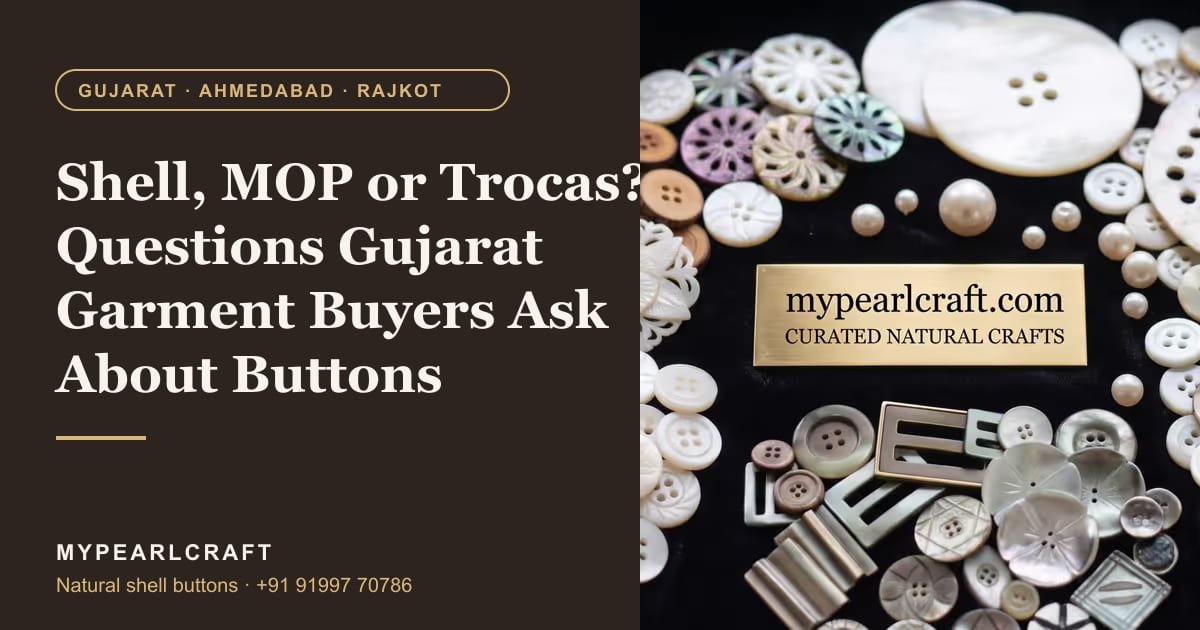
Mother-of-pearl is the shimmering inner layer of certain shells. Buttons cut from it have the pearly lustre people associate with fine shirts. When someone asks for "MOP buttons" they usually want the white, lustrous kind used on premium shirts and blouses.
What is trocas?
Trocas shell is a thick, heavy sea shell that gives buttons a smooth, solid feel. Trocas buttons are popular for jackets, blazers and coats, where a bigger, weightier button suits the garment. They tend to have a softer, more subdued lustre than the brilliant white of thin MOP.
Are shell and plastic buttons really different?
Yes, in three ways. Shell buttons feel cool and dense in the hand; plastic feels light and warm. Every shell button has slight natural variation, while plastic is perfectly uniform. And shell takes pressing and washing differently — it is durable, but harsh chemicals can dull it. Customers often notice and will pay for the difference on quality garments.
Which is better for shirts?
For classic shirts, white or cream MOP in 14L–18L, two- or four-hole, is the standard. It looks refined, matches both light and dark fabrics and stays comfortable against skin. Trocas is rarely used for fine shirts because it is thicker than the placket usually likes.
Which is better for kurtas and ethnic wear?
Natural shell in 20L–28L works well on kurtas, jackets and sherwanis, giving a rich look without extra embellishment. For bridal and festive work, latkans — tassels or pendants finished with top-hole shell discs — add movement and shine.
How do prices compare?
Plastic is cheapest. Shell costs more because it is a natural material cut, drilled and polished one at a time, and prices vary by thickness, size and quality. The honest way to compare is cost per garment: a few extra paise per button often adds little to the final price and allows a noticeably higher selling price.
Will every button look identical?
No, and that is part of the appeal. Natural shell varies in tone and lustre. Good suppliers sort buttons by shade so each garment gets a consistent set, but if you need perfect uniformity, plastic is the safer choice. Approve a range on sample buttons so you know what to expect.
Can shell buttons be washed and ironed?
Yes, with care. Normal washing is fine. Avoid bleach and strong acids, and keep a cloth between iron and button. For industrial laundry, test a few samples through the exact wash recipe first, or attach buttons after washing.
Do you need a minimum order?
For wholesale pricing, stock sizes usually start at a minimum quantity per size, confirmed in your quote. Smaller packs are available on our online shop for tailors and boutiques who want to try the product first.
Getting the specification right the first time
Tell the supplier the garment, size in ligne or millimetres, number of holes, shade and quantity, or send a photograph of your sample button with a ruler beside it. Ask for samples before bulk, test them on your fabric, and approve in writing.
How can I tell genuine shell from imitation?
Genuine shell feels cool and heavy, has fine natural growth lines and shows slight variation from button to button. Imitation plastic looks uniform and feels light and warm. Look at the edge under a magnifier: shell shows fine layers, while plastic is smooth throughout. If in doubt, ask your supplier what shell the button is cut from, and request a sample.
Do shell buttons work on machines?
Yes. Most automatic button-attach machines handle shell buttons well when diameter, thickness and hole position are consistent. Tell the supplier your machine type and thread gauge, test a short run and approve it before ordering bulk quantities.
What should I do if I am not sure of the size?
Send a photograph of your current button beside a ruler, or post a sample. We will suggest the nearest standard size in ligne and millimetres, and send samples to compare against your fabric before you decide.
Can I get custom sizes or shapes?
For bulk orders, sizes outside the standard range and special finishes can be discussed. Share a drawing or a sample, the quantity and the garment it is for, and we will tell you what is practical with natural shell, along with a realistic lead time. For small quantities, standard stock sizes are usually the faster and more economical choice.
How long does delivery to Gujarat take?
Stock sizes are dispatched by courier or transport soon after the order is confirmed; transit time depends on your city and the carrier. Custom work takes longer, so plan ahead of your selling season and ask for a confirmed dispatch date with your quote.
We make natural shell and mother-of-pearl buttons and ship across Gujarat. If you are unsure which type suits your garment, send us a picture and we will suggest the right one, with samples to check.
Order from the manufacturer
Ready to order shell buttons?
MyPearlCraft has made natural shell and mother-of-pearl buttons for 50+ years in its own unit. Send size, hole type, shade and quantity — or a photo of your sample button.
- 01
Send your spec - 02
Get a quote - 03
Approve samples - 04
We make & ship
Stock sizes usually start at 500–1,000 pieces per size for wholesale pricing (confirmed in your quote). Samples first. GST invoice on every order.
Topics