On this page
Most shirts made in Surat today use polyester buttons. They are cheap, uniform and available everywhere. But as more Surat manufacturers build their own brands and sell to quality-conscious retailers and online customers, the question keeps coming up: is it worth switching to natural shell buttons? This article compares shell and plastic honestly, so that you can decide which styles deserve the upgrade.
Look and feel
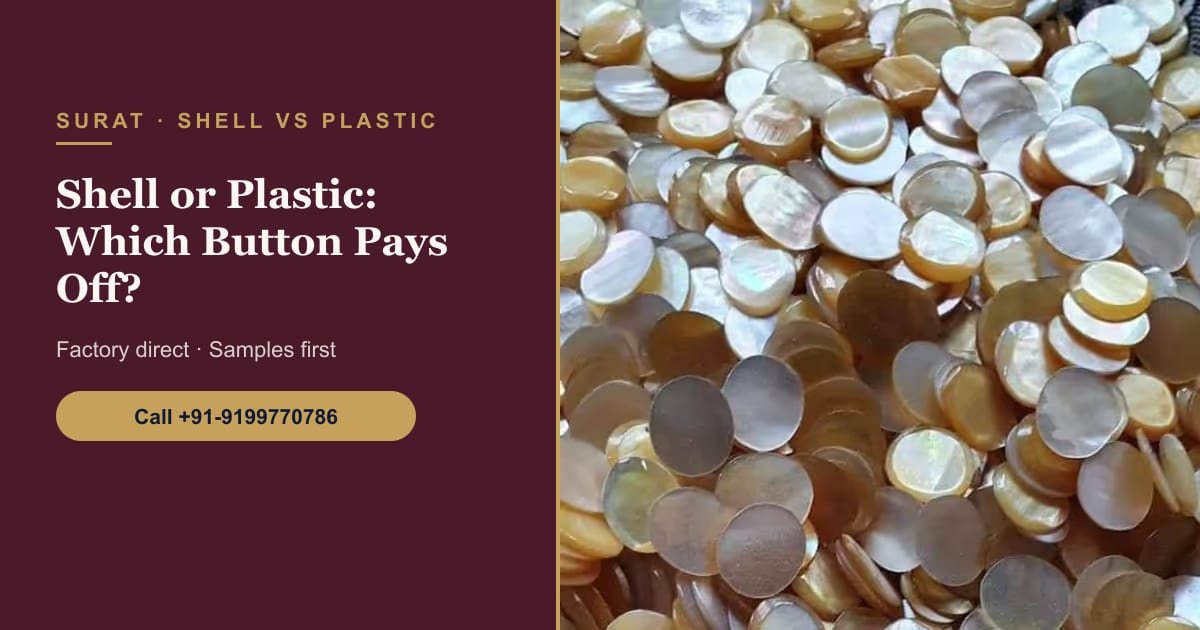
This is where shell wins clearly. A natural shell or mother-of-pearl button has depth: its surface shows layers of soft iridescence that shift with the light. It is cool to the touch and noticeably heavier. Polyester buttons can be made to imitate the shine, but they look flat up close, every button is identical, and they feel light and warm. Customers may not know the technical difference, but they feel it when they button the shirt in a trial room.
Durability and ironing
Shell is a hard, mineral material. It does not soften or melt under a hot iron — something that does happen to some cheap plastic buttons, leaving marks on the button and sometimes the fabric. Shell can chip if struck very hard, just as any hard material can, and strong bleach can dull its polish over time. For normal wear, washing and ironing, a well-made shell button lasts as long as the shirt.
Production on button machines
Both shell and plastic buttons can be attached on standard automatic button-sewing machines. The key with shell is consistency: thickness and hole position must be even across a lot, otherwise machines skip stitches or break needles. Buy from a supplier who sorts by thickness and drills holes cleanly. Plastic buttons are perfectly uniform by nature; good shell buttons are uniform because of careful finishing and sorting.
Consistency of shade
Plastic buttons are identical. Shell buttons are natural, so shade varies. For most shirts that variation is part of the charm, but within a single garment the buttons should look alike. That is why shell buttons are graded and sorted. Ask for samples of the grade you will receive in bulk and keep a reference card for reorders.
Cost per garment
Shell buttons cost more per piece than polyester. But it helps to think in cost per garment rather than per button. A shirt uses roughly 10 to 16 buttons across front, collar and cuffs. The extra cost of using shell on that shirt is a small part of the total cost of fabric, stitching and packing — and it can support a noticeably higher selling price. A simple way to start is to use shell only on the front placket, where it is most visible, and keep smaller collar and cuff buttons in a matching shade.
Selling price and positioning
Retail buyers and online customers associate mother-of-pearl buttons with premium shirts. Mentioning “genuine mother-of-pearl buttons” on a label, in a product title or in bullet points gives your shirt a specific, believable reason to cost more than a similar-looking competitor. It also helps reduce returns from customers who expected a better finish.
Environmental angle
Polyester buttons are made from petroleum and do not biodegrade. Shell is a natural material. For brands and buyers with sustainability goals, natural buttons are an easy, visible improvement.
Which styles should switch first?
- White and pastel formal shirts — white MOP makes the biggest visible difference.
- Linen and premium cotton shirts — natural cream shell matches the fabric story.
- Bestsellers sold online — where photos and descriptions can highlight the buttons.
- Private-label orders where the buyer asks for a premium finish.
Keep plastic for very price-sensitive basics until you see how shell performs on your premium lines.
Comparison at a glance
- Look: shell natural depth and variation; plastic flat and uniform.
- Feel: shell cool and heavier; plastic light.
- Ironing: shell heat-tolerant; some plastics can soften.
- Uniformity: plastic identical; shell graded and sorted.
- Cost: plastic lower per piece; shell higher but supports a better price.
- Material: plastic petroleum-based; shell natural.
Running a simple trial
The easiest way to decide is to test. Take one bestselling shirt style and make a small batch with shell buttons on the front placket. Sell it alongside the plastic-button version, or list it online at a slightly higher price with a close-up photo of the button. Watch sell-through, returns and customer reviews over a few weeks. Real data from your own customers is more convincing than any general argument.
Whatever you decide, keep the two button types clearly separated in your trims store so that shell buttons are never mixed into a plastic-button lot by mistake.
FAQs
Can I use shell on the front and plastic on the collar?
You can, but customers may notice the difference. Small shell buttons for collar and cuffs in the same shade give a more consistent finish.
Do shell buttons break on button machines?
Not when thickness and holes are consistent. Approve samples on your own machine before bulk production.
Call +91-9199770786 to talk to the manufacturer directly.
Order from the manufacturer
Need shell buttons for Surat?
MyPearlCraft has made natural shell and mother-of-pearl buttons for 50+ years in its own unit. Send size, hole type, shade and quantity — or a photo of your sample button.
- 01
Send your spec - 02
Get a quote - 03
Approve samples - 04
We make & ship
Stock sizes usually start at 500–1,000 pieces per size for wholesale pricing (confirmed in your quote). Samples first. GST invoice on every order.
Topics