On this page
- 1. Confirm size in two units
- 2. Match the buttonhole
- 3. Check hole count and quality
- 4. Approve a shade range
- 5. Test attachment and wash
- 6. Compare the full cost
- 7. Fix delivery and repeat terms
- Common mistakes Surat factories can avoid
- Keep a sample record
- When to start with a small order
- Why Surat factories benefit most from checking early
- A sample approval form that works
- Involving the machine operator
- Planning repeat lots after approval
- Keeping costs predictable
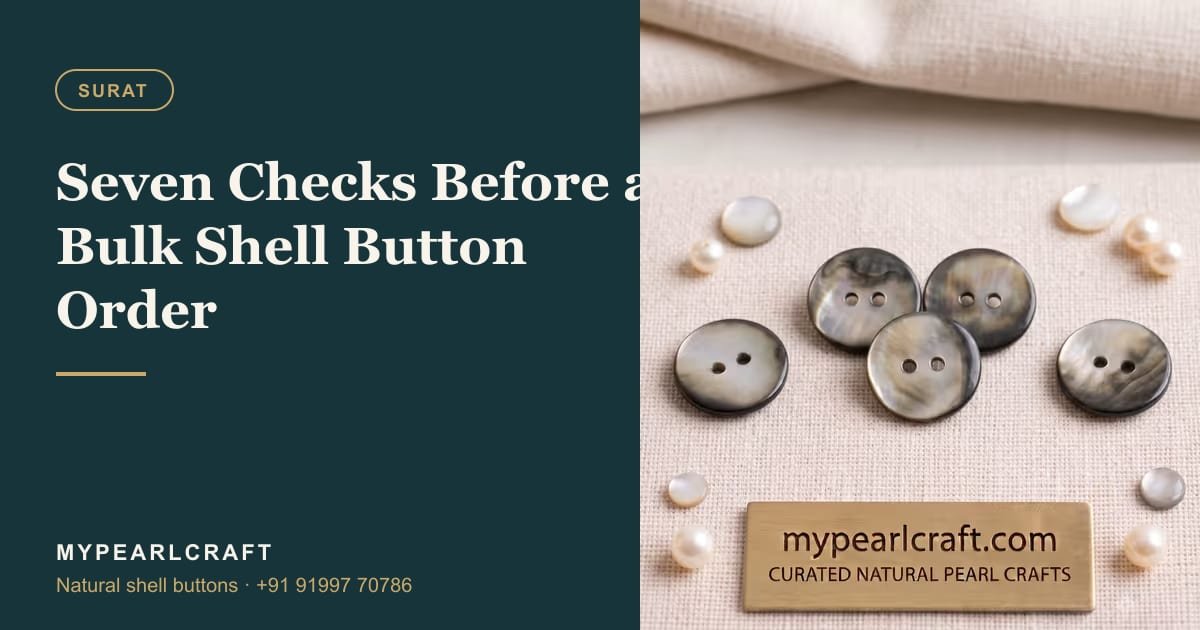
A bulk order of buttons is a small purchase measured against the value of the garments it goes on, yet it can stop a whole lot when it goes wrong. For Surat’s shirt, kurta and ethnic-wear factories, the fix is not complicated: most faults can be found at sample stage if you know what to check. This guide gives seven checks to run before you commit to a bulk order of natural shell buttons.
1. Confirm size in two units
Write the button size in both ligne and millimetres, and measure the sample yourself. A button called 18L should measure close to 11–12 mm. Differences of even half a millimetre change how the button sits in a buttonhole, so make the measurement part of your approval, not a guess.
2. Match the buttonhole
Take the sample to your buttonhole machine and test on real fabric. The hole should be roughly the button diameter plus its thickness. Too tight and the button fights the cloth; too loose and it slips open. Do this with every size you plan to use.
3. Check hole count and quality
Two holes or four, and clean ones. Hold the button against light: holes should be centred, round and free of rough edges. Run a thread through to feel for catching. Poor holes mean thread breaks, and thread breaks mean stoppages.
4. Approve a shade range
Because shell varies naturally, ask for a shade range rather than a single button, and keep the approved range as your reference. Check it in daylight against your fabric. When bulk arrives, compare against the same reference so there is no argument later.
5. Test attachment and wash
Sew samples onto offcuts with your thread and machine, then pull sideways. If your garments go through a wash, run the offcuts through the same recipe. Pearl dulls under strong acids or heat, so find out now. If the recipe is harsh, attach after washing.
6. Compare the full cost
Do not judge by rate per piece alone. Ask whether the price covers sorting by shade, counted packing and delivery, and consider the cost of rejects and delays. A slightly higher rate from a supplier who delivers consistent lots is usually cheaper in the end.
7. Fix delivery and repeat terms
Agree the delivery date in writing, the number of pieces per pack, and what happens if part of the lot is out of specification. If you expect to reorder, ask whether the same shade lot can be matched and how far ahead you should place repeat orders.
Common mistakes Surat factories can avoid
- Approving from a photograph instead of a physical sample.
- Ordering a mixed carton instead of sorted lots by size.
- Skipping the wash test on garments that are industrially laundered.
- Splitting one garment batch across different shade lots.
Keep a sample record
Seal one approved sample of each size and shade in a labelled bag and keep it on file with the order number and date. Months later, when a repeat lot arrives or a buyer questions a shade, you will have an exact reference. It costs nothing and settles most disagreements in minutes.
When to start with a small order
If you are trying shell for the first time, begin with a modest quantity on one style. You learn how it behaves on your machines and with your buyer before committing the whole range. Many factories find that after one trial run, the larger order is a straightforward decision.
Why Surat factories benefit most from checking early
Surat’s factories often run large, fast cycles of shirts, kurtas and ethnic wear, with embroidery and finishing stages after stitching. A faulty trim discovered at the end means unpicking finished work, which is expensive and slow. A short check at sample stage costs minutes and removes most of that risk.
A sample approval form that works
Create a one-page form for every trim approval: style number, button size in ligne and millimetres, number of holes, shade reference, quantity, date and the name of the approver. Staple the approved sample to the form. Next time the order is repeated, anyone in the factory can match it exactly without phone calls or memory.
Involving the machine operator
Operators know what makes a button easy or hard to attach. Ask the person who will actually use the button to try the sample and tell you what they think. A quick comment about holes, thickness or edges from the sewing floor is often more useful than any specification sheet.
Planning repeat lots after approval
Once a button is approved, plan repeat orders ahead of your production calendar instead of waiting until stock runs out. Give your supplier an idea of monthly consumption, so shade-matched lots can be prepared in time. Share any change in your styles early too. Steady, predictable orders are easier to fulfil consistently, and that consistency is exactly what your buyers notice on the finished garments.
Keeping costs predictable
Ask for a price list per size at the volumes you normally buy, and review it once or twice a year rather than negotiating every order. Predictable rates make costing garments simpler and let your sales team quote buyers with confidence.
We manufacture natural shell and mother-of-pearl buttons ourselves and dispatch to Surat. Send your sizes and quantities and we will quote and send samples for approval before you place the bulk order.
Order from the manufacturer
Need shell buttons for Surat?
MyPearlCraft has made natural shell and mother-of-pearl buttons for 50+ years in its own unit. Send size, hole type, shade and quantity — or a photo of your sample button.
- 01
Send your spec - 02
Get a quote - 03
Approve samples - 04
We make & ship
Stock sizes usually start at 500–1,000 pieces per size for wholesale pricing (confirmed in your quote). Samples first. GST invoice on every order.
Topics