On this page
Hyderabad has a garment economy with two very different sides. On one side are uniform, workwear and private-label units supplying corporates, schools and retail chains. On the other is one of India’s strongest fashion-design scenes, with couture labels, bridal ateliers and occasion-wear designers working in Banjara Hills, Jubilee Hills and across the city. Both sides have something in common: they want buttons that look better than plastic. This guide explains how Hyderabad buyers can source natural shell and mother-of-pearl (MOP) buttons in bulk, directly from a manufacturer.
Shell, mother of pearl, seep: what is the difference?
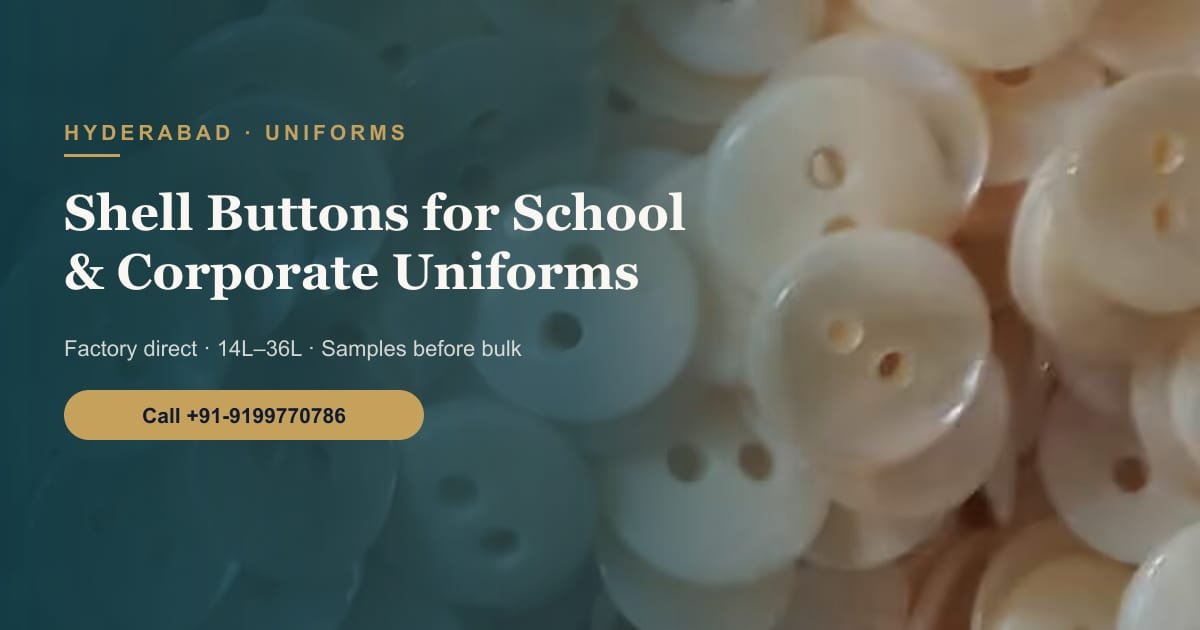
In everyday trade these words describe the same family of material. Mother of pearl is the iridescent inner layer of a shell; shell button is the general term; and seep or sipi is how many buyers in North and Central India ask for it. What matters for you is that the button is cut from real shell and not moulded from polyester to imitate it. Real shell is cool to touch, slightly heavier, and shows natural layers and variation that no plastic can copy.
For designers and ateliers
For a designer, a button is part of the story of the garment. A white mother-of-pearl button on a silk kurta, a natural cream shell on a linen bandhgala, or a larger 24L to 32L shell button on a jacket instantly lifts the piece. Hyderabad designers we speak with typically want:
- Small quantities in several sizes for a collection, rather than one huge lot;
- Specific shades — bright white, soft cream or mixed natural;
- Special thickness or polish for occasion wear;
- Single top-hole discs for tassels, latkans and hanging trims.
For smaller requirements our online shop is the quickest route; for collection runs, a direct enquiry lets us cut and sort exactly what you need. Our top-hole shell discs are made from the same shell as our buttons, so trims and buttons match.
For uniform and private-label manufacturers
Volume buyers care about different things: consistency, durability and price. Shell buttons are hard and heat-tolerant, so they survive ironing better than many plastics, and they give premium uniforms and corporate shirts a noticeably better finish. Typical specifications are 16L to 20L in 4-hole for shirt fronts, 14L for collars and cuffs, and 24L and above for jackets. We sort every bulk order by shade and thickness so that a full production run stays even, and we can repeat lots for future orders.
Size guide in brief
- 14L ≈ 9 mm — collars, cuffs, kidswear
- 16L ≈ 10 mm — light shirts and blouses
- 18L ≈ 11.4 mm — the standard shirt-front size
- 20L ≈ 12.7 mm — heavier shirts, kurtas
- 24L ≈ 15.2 mm — overshirts, dresses, light jackets
- 28L–36L ≈ 18–23 mm — jackets, coats, statement pieces
If your pattern specifies millimetres, share them and we will match or cut to size.
How to judge quality quickly
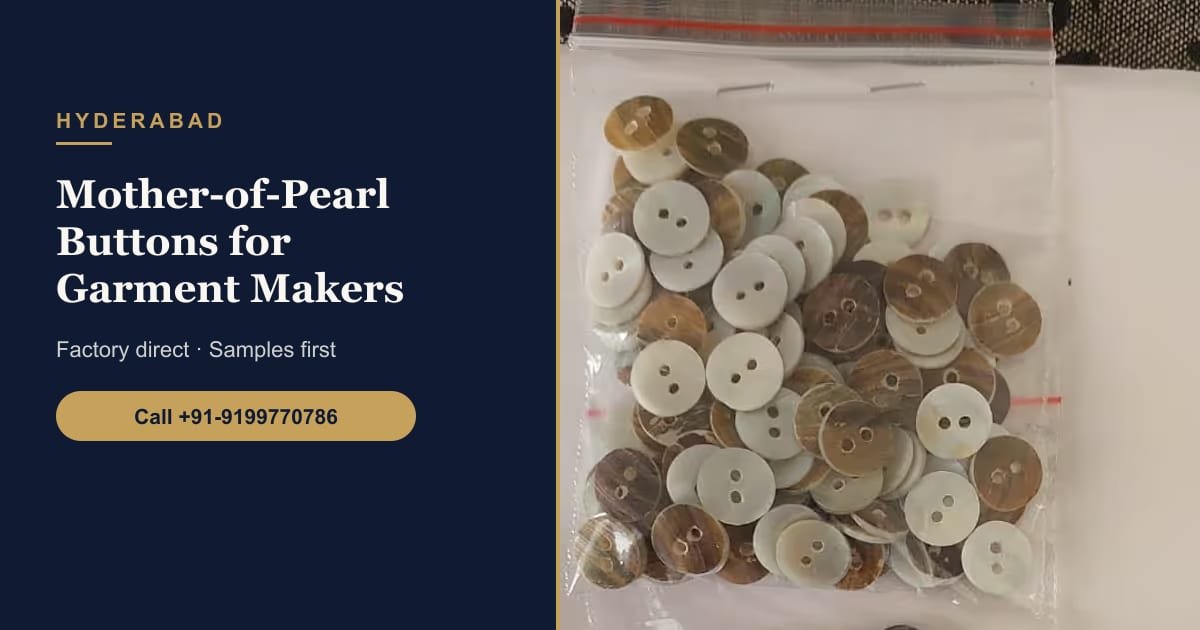
Hold a few buttons from the sample under daylight. The surface should be smoothly polished with a clean rim; holes should be centred and free of chips; thickness should feel the same across pieces; and the shade should sit within a narrow range. Drop one on a hard floor: real shell gives a clear, slightly ceramic click, while plastic sounds dull. These simple checks will tell you most of what you need to know.
Bridal and festive wear: getting the details right
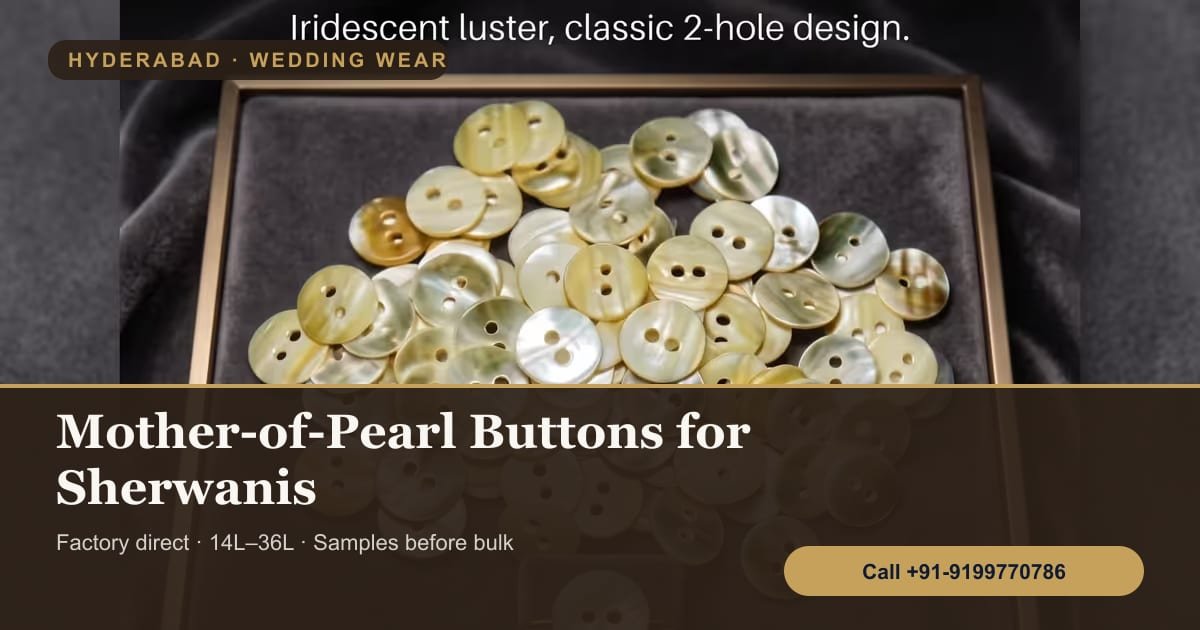
Hyderabad’s bridal and festive market is demanding. Sherwanis, bandhgalas, anarkalis and lehenga blouses often carry rows of small buttons where every piece is visible up close and photographed at weddings. For these garments we suggest choosing the shade against the actual fabric under warm indoor light, since that is how the garment will be seen. White mother of pearl adds a bright, jewel-like accent on deep colours such as maroon, bottle green and navy, while natural cream shell feels softer and more traditional on ivory, gold and pastel silks. Thicker buttons with a high polish read as more luxurious. If a design needs a row of perfectly matched buttons, tell us; we will select them from the same sorted batch so that the row looks even from top to bottom. For heavy embroidery, sew the buttons on after embellishment so that the surface is not scratched during handwork.
FAQs
Can I order mixed sizes for a design collection?
Yes. Tell us the sizes and quantities and we will quote a mixed order; minimums per size may apply for wholesale pricing.
Do shell buttons work with dyed fabric?
Shell buttons are usually attached after dyeing. If buttons must go through garment dyeing, test samples first, as the process can affect the surface.
Talk to the manufacturer directly: +91-9199770786.
Order from the manufacturer
Need shell buttons for Hyderabad?
MyPearlCraft has made natural shell and mother-of-pearl buttons for 50+ years in its own unit. Send size, hole type, shade and quantity — or a photo of your sample button.
- 01
Send your spec - 02
Get a quote - 03
Approve samples - 04
We make & ship
Stock sizes usually start at 500–1,000 pieces per size for wholesale pricing (confirmed in your quote). Samples first. GST invoice on every order.
Topics